Struggling with slow, uneven, or even risky knife work? You’re not alone. Inefficient cutting is one of the biggest obstacles between you and faster, more enjoyable cooking. This basic knife skills guide strips away the fluff and focuses on the core techniques that instantly improve your speed, safety, and precision. Instead of just showing you different cuts, we break down the how and why behind proper grip, posture, and blade movement—so every slice feels controlled and confident. If you’re ready to build real kitchen competence and transform prep from a chore into a skill, this guide gives you the clear, practical roadmap to get there.
The Foundation: Your Knife, Your Grip, Your Stance
“Do I really only need one knife?” a student once asked. Yes—start with an 8-inch chef’s knife. It’s the kitchen workhorse: versatile enough for herbs, onions, or breaking down a chicken. Prioritize balance (how evenly the weight is distributed between blade and handle) and a handle that feels secure over flashy brand names. As one chef told me, “If it feels right in your hand, it is the right knife.”
Next, the pinch grip. Instead of clutching the handle, pinch the blade where it meets the handle with your thumb and index finger. Wrap the remaining fingers around the handle. This grip increases control and precision. “It’s like holding a paintbrush closer to the bristles,” another cook explained. In any basic knife skills guide, this is the gold standard.
Meanwhile, your non-dominant hand forms the claw grip: fingertips curled under, knuckles forward. Your knuckles guide the blade; your fingertips stay protected. (Yes, it feels awkward—until it doesn’t.)
Finally, stabilize your board with a damp towel underneath and stand comfortably. Good posture creates fluid motion—essential whether you’re dicing onions or learning how to meal prep for a week of healthy dinners.
The Core Techniques: Mastering the Essential Cuts
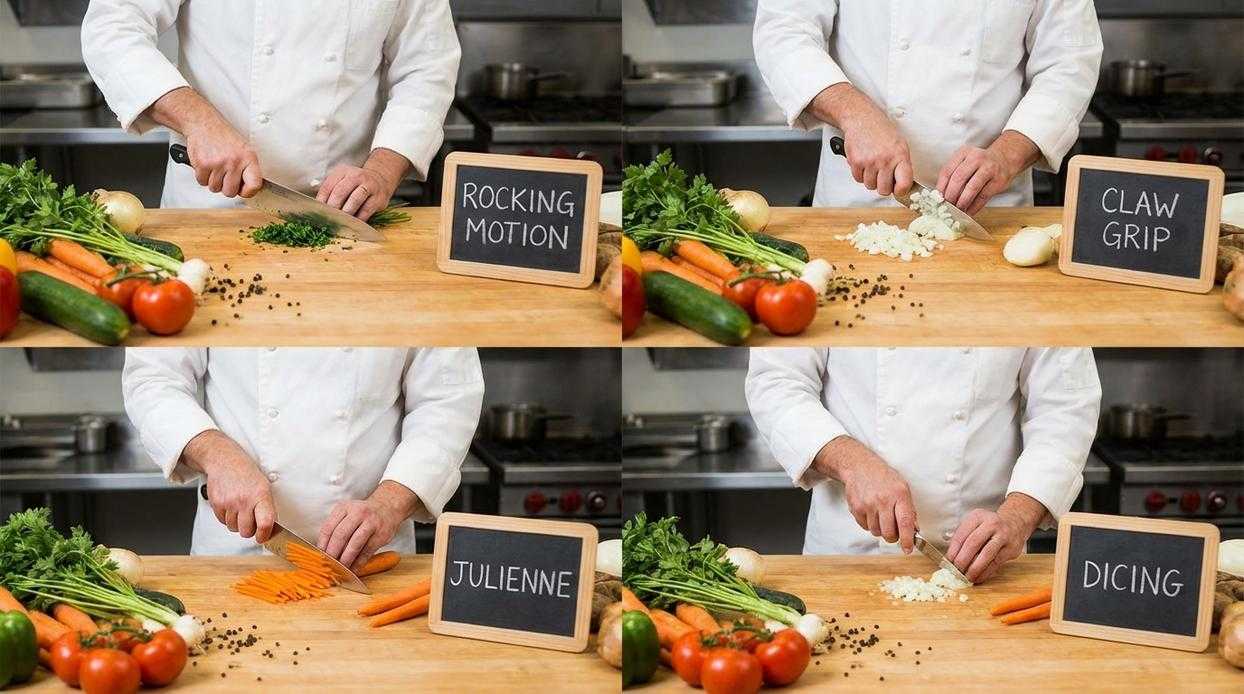
Great cooking starts with control. And control starts with knife technique. Master these four essential cuts, and you’ll move through prep like you actually know what you’re doing (because you will).
The Slice (The Push Cut)
The slice—also called the push cut—is your go-to for onions, mushrooms, and celery.
Here’s how:
- Place the knife tip on the board.
- Push the blade forward and down in one smooth motion.
- Let the heel finish the cut.
This forward glide prevents crushing delicate vegetables. For example, when slicing mushrooms, a straight downward chop bruises them. The push cut keeps edges clean and even.
Pro tip: Keep your guiding hand in a “claw” shape—fingertips tucked, knuckles forward—to protect them and guide thickness.
The Dice (Cross-Cutting)
Dicing is the universal cut behind soups, stews, and mirepoix (a mix of onion, carrot, and celery used as a flavor base).
Using a potato:
- Slice into even planks.
- Stack and cut into sticks (called batons).
- Rotate and cross-cut into cubes.
Control size by spacing your cuts: small dice for quick sautés, medium for soups, large for roasting. Consistency ensures even cooking—no half-raw surprises.
The Julienne (Matchsticks)
Julienne creates thin, matchstick-sized strips.
Start by squaring off a carrot—trim the rounded sides to form flat edges. This creates stability (rolling vegetables are chaos waiting to happen). Cut thin planks, stack them, then slice into uniform sticks.
These are perfect for stir-fries or fresh slaws where texture matters.
The Mince (The Rocking Chop)
For garlic, shallots, and herbs, use a rocking motion.
- Gather ingredients into a pile.
- Place one hand on the blade spine.
- Keep the tip anchored.
- Rock up and down.
This creates a fine, even mince without smashing flavors.
Practice these daily—it’s the foundation of any basic knife skills guide and the difference between home cook and kitchen ninja.
Putting It Into Practice: Your First Five Vegetables
Mastering knife skills starts with five humble vegetables—each one a hands-on lesson in control, stability, and precision (yes, even the tear-jerking onion).
The Onion: Your ultimate training ground. Use the root-to-tip method: slice the onion in half through the root, keep that root intact, make horizontal cuts toward it, then vertical slices, and finish with downward cuts for a clean dice. The root acts like a hinge, holding everything together for uniform pieces.
The Carrot: Cylindrical and prone to rolling, it teaches safety first. Slice off a thin strip to create a flat base before practicing rounds, sticks, small dice, and julienne (thin matchstick cuts). Stability equals confidence.
The Bell Pepper: Cut off the top and bottom, then slice down one side to open it. Trim away the core and seeds, flatten the walls into planks, and slice or dice evenly. Efficient and waste-conscious.
Celery: Perfect for consistent slices and fine dice. Focus on even spacing—uniform cuts cook evenly and look professional.
Garlic: Practice the mince by crushing a clove with your blade, removing the skin, then rocking the knife for a fine texture. Small ingredient, big flavor payoff.
For deeper practice, follow a basic knife skills guide and repeat often (channel your inner cooking-show finalist).
A Sharper Skillset: Honing vs. Sharpening
Honing and sharpening sound interchangeable, but they’re not. Honing uses a steel rod to realign an sharp edge; sharpening removes metal to create a brand-new edge. Think maintenance vs. makeover.
Side-by-side:
- Hone: touch-up, no metal removed, ideal before cooking.
- Sharpen: reshapes bevel, restores dull blades, needed only few times yearly.
Some argue sharpening alone is enough. But skipping honing is like ignoring tire pressure (things slide fast). A sharp knife is safer—it bites, not slips. Follow basic knife skills guide: hone often, sharpen occasionally. Pro tip: test sharpness on paper, not fingers.
With these essential knife skills mastered, you’ll be well-equipped to experiment with the surprising flavors found in our article on Unexpected Ingredient Combinations Worth Trying.
From Prep Work to Knife Work: Your Path Forward
You came here to move from hesitant chopping to confident slicing—and now you have the tools to do it. With the pinch grip, the claw, and the essential cuts in your arsenal, slow and uneven prep work no longer has to frustrate you. The real transformation happens through repetition. Consistent practice is the permanent cure for kitchen clumsiness.
If you’re ready to turn knowledge into skill, revisit this basic knife skills guide and put it into action tonight. Choose one vegetable. Master one cut. Thousands of home cooks sharpen their confidence this way—now it’s your turn. Grab your knife and start slicing.
 Kitchen Operations & Prep Specialist
There is a specific skill involved in explaining something clearly — one that is completely separate from actually knowing the subject. Brandon Schwartzimba has both. They has spent years working with culinary buzz in a hands-on capacity, and an equal amount of time figuring out how to translate that experience into writing that people with different backgrounds can actually absorb and use.
Brandon tends to approach complex subjects — Culinary Buzz, Curious Insights, Fusion Meal Ideas being good examples — by starting with what the reader already knows, then building outward from there rather than dropping them in the deep end. It sounds like a small thing. In practice it makes a significant difference in whether someone finishes the article or abandons it halfway through. They is also good at knowing when to stop — a surprisingly underrated skill. Some writers bury useful information under so many caveats and qualifications that the point disappears. Brandon knows where the point is and gets there without too many detours.
The practical effect of all this is that people who read Brandon's work tend to come away actually capable of doing something with it. Not just vaguely informed — actually capable. For a writer working in culinary buzz, that is probably the best possible outcome, and it's the standard Brandon holds they's own work to.
Kitchen Operations & Prep Specialist
There is a specific skill involved in explaining something clearly — one that is completely separate from actually knowing the subject. Brandon Schwartzimba has both. They has spent years working with culinary buzz in a hands-on capacity, and an equal amount of time figuring out how to translate that experience into writing that people with different backgrounds can actually absorb and use.
Brandon tends to approach complex subjects — Culinary Buzz, Curious Insights, Fusion Meal Ideas being good examples — by starting with what the reader already knows, then building outward from there rather than dropping them in the deep end. It sounds like a small thing. In practice it makes a significant difference in whether someone finishes the article or abandons it halfway through. They is also good at knowing when to stop — a surprisingly underrated skill. Some writers bury useful information under so many caveats and qualifications that the point disappears. Brandon knows where the point is and gets there without too many detours.
The practical effect of all this is that people who read Brandon's work tend to come away actually capable of doing something with it. Not just vaguely informed — actually capable. For a writer working in culinary buzz, that is probably the best possible outcome, and it's the standard Brandon holds they's own work to.